


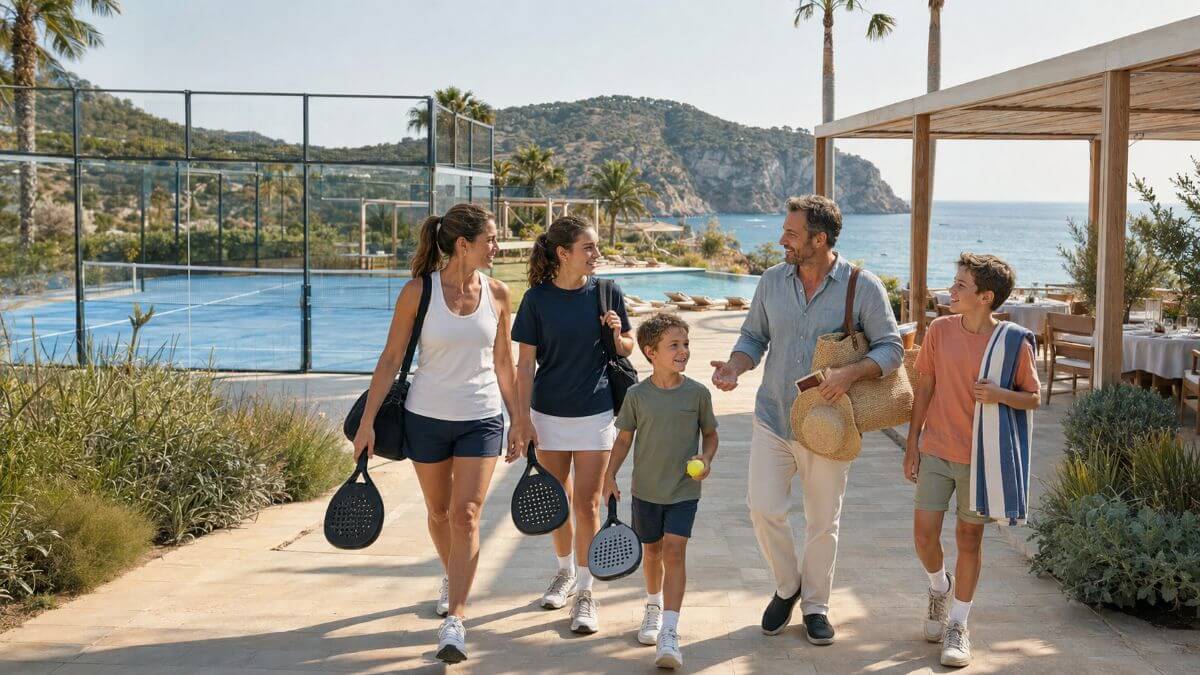
A family padel holiday sounds simple until you begin planning around the family you actually have.
One parent may want regular coaching. The other may not want to play at all. A teenager may be ready for competitive matches but still want time away from the family. A younger child may enjoy one short lesson before deciding that the pool is far more interesting.
None of that makes padel the wrong choice.
It means the trip should be designed as a family holiday with padel in it, rather than an adult training camp with children added afterwards.
The strongest family padel holidays give each person an appropriate amount of court time, relaxation, adventure and bonding. Keep transfers simple and protect the parts of the trip everyone wants to share: lunches, beach days, excursions and relaxed evenings.
Quick Answer: Are Padel Holidays Good for Families?
Yes. Padel can work well for families because it is normally played in doubles, uses an underarm serve and can allow different generations to share a social game without every point becoming highly competitive. These can still be beach holidays, with many coastal destinations offering padel with other sports.
LTA Padel describes the smaller court and doubles format as reasons families with different standards can sometimes sustain rallies and enjoy court time together more easily than in some other racket sports.
A successful family trip usually needs:
| Family need | What to arrange |
|---|---|
| Different playing standards | Separate coaching groups with selected shared games |
| Younger children | Short, game-led sessions and plenty of non-padel time |
| Teenagers | Level-matched coaching, privacy and age-appropriate independence |
| A non-playing parent | A hotel with worthwhile facilities and an appealing local area |
| Shared family time | Protected meals, excursions and padel-free days |
| Practical accommodation | A room layout that works after the children go to bed |
| Simple logistics | Courts close to the hotel or reliable transfers |
| Hot weather | Morning or evening play, shade and regular hydration |
| Additional needs | Accessible courts, adaptable coaching and clear communication |
| Seasonal travel | Written confirmation that pools, clubs and restaurants will be open |
The question is not simply whether the hotel has padel courts.
It is whether the whole holiday still works when somebody does not want to play.
A Real Family Example: Three Generations on One Court
LTA Padel has profiled the Fyfe family in Sheffield, where three generations play together regularly. The group includes 75-year-old David Fyfe, his sons and grandchildren.
Their experience illustrates one of padel’s family strengths: a social game can sometimes accommodate a wider mix of ages and standards than a formal singles sport. It does not mean every family member should receive the same coaching or play at the same intensity.
That is the balance to aim for on holiday:
- Separate instruction where it improves the experience
- Shared court time where it remains enjoyable
- No pressure to turn a family knockabout into serious competition

Start by Asking What Everybody Wants
Before comparing resorts, establish what role padel should play for each traveller.
| Family member | What they may want | Useful arrangement |
|---|---|---|
| Regular-playing parent | Coaching and competitive match play | Intermediate or advanced sessions |
| Beginner parent | A relaxed introduction | Beginner clinic or private lesson |
| Younger child | Games and simple skills | Short junior session |
| Older child | Progress and social play | Junior coaching or family doubles |
| Teenager | Better opponents and independence | Level-matched coaching and optional matches |
| Non-playing parent | Pool, spa, beach, town or excursions | Defined court blocks and strong hotel facilities |
Ask everyone separately where possible.
A teenager may agree to daily padel because a parent sounds excited, then discover that every session replaces pool time. A non-playing parent may assume the courts are beside the hotel, only to learn that the programme uses several clubs.
A short conversation before booking is easier than resolving resentment after arrival.
Match Coaching to Ability, Not Family Position
Being related does not make people suitable coaching partners.
A stronger parent may want tactical work. A child playing for the first time needs simple contact, basic rules and safe movement. A teenager with previous tennis or squash experience may progress faster than either adult.
Padel Holidays says a good trip should combine quality courts, coaching suited to the player’s level, comfortable accommodation and enough free time to enjoy the destination. Its guidance also recommends describing standards honestly so organisers can build appropriate coaching groups and balanced matches.
Complete Beginners
A first lesson should usually prioritise:
- Court layout
- Underarm serve
- Simple scoring
- Forehand and backhand contact
- Basic doubles positions
- Moving safely
- Communicating with a partner
The goal is not to teach every shot. It is to make the game feel understandable.
Younger Children
LTA Padel says children as young as four can begin enjoying the sport, although individual venues set their own age limits and programme rules. It also recommends slower orange or green balls for some young beginners because they give children more time to reach and control the ball.
For younger children, ask whether the lesson is:
- Game-led
- Broken into short activities
- Adapted to the child’s attention span
- Delivered with junior rackets
- Organised by both age and ability
- Supported by suitable safeguarding arrangements
Older Children and Teenagers
Teenagers should not automatically be placed with much younger children simply because they are under 18.
Depending on their level, they may prefer:
- Teen coaching
- Competitive junior sessions
- Private lessons
- Social games with parents
- Matches with other teenagers
- An adult improver session, where the venue permits it
Any teenager joining an adult group should do so only when the coach and venue allow it and the relevant safeguarding and parental arrangements are in place.
The LTA Padel Instructor qualification covers coaching adults and juniors, inclusion, safeguarding and competition organisation. Its current prerequisites also include accreditation or an appropriate enhanced DBS/PVG check and first-aid certification.
Experienced Players
A regular player may want:
- Tactical coaching
- Advanced drills
- Local opponents
- Competitive match play
- A tournament
- Private instruction
Those sessions can sit within the family holiday, but they should be placed in defined blocks rather than scattered across every day.

How Much Padel Should Children Play?
There is no universal session length that suits every child.
Age, experience, concentration, weather and coaching style all matter.
| Age or stage | Better planning approach |
|---|---|
| Younger child | Short, game-led introduction with breaks |
| Primary-age beginner | Structured coaching adjusted to attention and confidence |
| Older child | Technical coaching mixed with games and challenges |
| Teenager | Longer level-matched coaching or social match play |
| Adult beginner | One principal session on selected days |
| Regular adult player | Coaching or matches balanced with family plans |
A child who is still enjoying the session is more likely to want to return.
Stopping after a positive 40 minutes can be better than filling a two-hour booking simply because the court has been paid for.
Keep Padel in One Part of the Day
A concentrated morning schedule is usually easier than several separate court bookings.
A Family-Friendly Day
Morning: adult and junior coaching
Late morning: return to the hotel
Lunch: together
Afternoon: pool, beach or excursion
Evening: shared dinner
A Fragmented Day
09:00: one parent plays
12:00: junior lesson
15:00: transfer to another club
17:00: teen match
20:00: tired family tries to organise dinner
The first rhythm gives padel a clear place.
The second allows it to dominate the holiday.
Padel Holidays also advises that more court time does not necessarily create a better trip, particularly in warm weather. Its guidance recommends balancing coaching and matches with rest and time to explore.
Give Teenagers Some Independence
Teenagers may enjoy family travel more when they are not expected to follow their parents continuously.
That does not mean removing boundaries. It means choosing a destination where sensible independence is practical.
Useful features include:
- A walkable resort
- Reliable Wi-Fi
- A pool or sports area
- Cafés or shops nearby
- A teen programme
- A room layout with some privacy
- Agreed meeting points and times
- Clear rules about leaving the hotel
- A reliable way to contact parents
A teenager may prefer time by the pool or at the sports area to another organised family excursion.
Offer choices within agreed limits:
Would you rather join the boat trip or stay at the resort and meet us for dinner?
That is different from filling every day without consulting them.
Make the Holiday Work for a Non-Playing Parent
A family padel holiday can still work when only one parent plays.
The non-player should not spend several hours waiting at a remote club with young children and no independent transport.
Prioritise:
- Pool and shaded areas
- Beach access
- Spa or gym
- Walkable cafés and shops
- Children’s facilities
- Local parks or attractions
- Reliable transport
- A comfortable room
- Short court transfers
- Shared afternoons and evenings
A useful test is:
Would the non-playing parent still choose this hotel if the padel programme disappeared?
If the answer is no, the hotel may be too dependent on one person’s hobby.
What to Look for in a Family Padel Resort
Courts and Transfers
On-site courts are convenient, but a strong external club can also work when transfers are short and clearly organised.
Ask:
- How far is the club from the hotel?
- How long does the journey take in traffic?
- Are child seats available?
- Are transfers included?
- Must the whole family travel?
- Can one parent return early with a tired child?
- Are changing rooms and showers available?
- Are courts covered or indoors?
A Family Room That Really Fits
“Family room” is not a standard room type.
It may mean:
- One bedroom with a sofa bed
- A larger open-plan room
- Two sleeping zones
- Interconnecting rooms
- A suite with a separate living room
- A two-bedroom apartment
The difference matters after bedtime.
At Tivoli Alvor Algarve, for example, the standard Family Room is marketed for parents with smaller children, while the Family Deluxe Room has two sleeping areas separated by the en-suite bathroom. The property also offers larger two-bedroom and suite configurations.
Before booking, request:
- A floor plan
- Exact bed types
- Maximum occupancy
- Door and bathroom positions
- Cot availability
- Interconnecting-room confirmation
- Whether a teenager has a proper bed
- Whether the quoted room type is guaranteed
A room may technically sleep four while still being uncomfortable for a week.
Pools and Kids’ Clubs
Check:
- Pool opening dates
- Whether outdoor pools are heated
- Children’s pool depth
- Lifeguard arrangements
- Waterslide restrictions
- Indoor-pool age rules
- Kids’-club dates and daily hours
- Minimum and maximum ages
- Whether advance booking is required
- Whether activities cost extra
- Whether younger children need an accompanying adult
Tivoli Alvor currently lists six pools, a junior club, beach access, a wellness centre and several restaurants. Its Junior Club is intended for children aged four to 14; younger children must be accompanied by a responsible adult. Its wellness facilities also have a minimum access age of 16.
This is one resort’s policy, not a general rule. The important lesson is to verify the detail behind every facility label.
Restaurants, Laundry and Storage
Useful family features include:
- Early dining times
- Children’s menus
- Highchairs
- Fridge or kettle
- Flexible breakfast
- Allergy information
- Laundry service
- Drying space
- Wet-kit storage
- Enough wardrobe space
Sports kit, swimming costumes and children’s clothes accumulate quickly. These practical details often matter more by day four than another decorative hotel feature.
Check Seasonal Facilities Before Booking
The hotel shown in summer photographs may offer a reduced programme in April, October or winter.
| Facility | What to confirm |
|---|---|
| Kids’ club | Dates, hours, age limits and booking rules |
| Outdoor pools | Opening dates, heating and supervision |
| Indoor pool | Whether children can use it |
| Waterslides | Seasonal operation and height rules |
| Restaurants | Which venues will be open |
| Beach services | Lifeguards, shuttles and facilities |
| Entertainment | Whether the full programme operates |
| Babysitting | Availability, cost and notice |
| Junior coaching | Minimum age and coach availability |
| Padel courts | Covered option and weather policy |
| Excursions | Seasonal timetable and minimum numbers |
| Transport | Reduced off-season schedules |
Ask for important facilities to be confirmed in writing.
“Kids’ club available” is not enough when it operates only during selected school holidays.
Hot-Weather Padel with Children
Warm-weather play requires more planning than simply applying sun cream before leaving the hotel.
The NHS advises people exercising in hot weather to drink more fluids, wear light clothing and avoid the strongest sun between 11am and 3pm. Children are among those more vulnerable to heat exhaustion and heatstroke.
For outdoor family sessions:
- Choose early-morning or late-afternoon court times
- Carry more water than you expect to need
- Schedule regular shade breaks
- Use light, breathable clothing
- Apply suitable sun protection
- Keep a dry change of clothing nearby
- Stop the session if a child feels dizzy, sick, unusually tired or very thirsty
Heatstroke is a medical emergency. Follow local emergency guidance if symptoms are severe or do not improve with cooling and fluids.
Accessibility, Disability and Additional Needs
Do not assume that “family-friendly” means accessible to every family.
LTA Padel describes the sport as adaptable for wheelchair users, people with learning disabilities and players with long-term health conditions. It also highlights inclusive programmes and adjusted rules, such as allowing two bounces in wheelchair padel.
Before booking, ask about:
- Step-free access to courts and hotel facilities
- Accessible transfers
- Court-gate width
- Adapted equipment
- Accessible changing rooms and toilets
- Private or quieter sessions
- Coaches experienced with additional needs
- Clear visual schedules
- Reduced noise or smaller groups
- Rest areas close to the court
- Flexibility if a child becomes overwhelmed
For a neurodivergent child, a predictable timetable, familiar equipment and fewer transitions may make the experience more manageable. Discuss the child’s needs directly with the provider rather than relying on a generic inclusivity claim.
What Equipment Do Children Need?
Do not buy an expensive junior kit before checking what the venue supplies.
Many clubs offer rackets and balls for hire. LTA Padel also notes that junior rackets are lighter and have shorter grips, while slower balls can help some children learn.
A basic junior padel bag might include:
- Comfortable court shoes or supportive trainers
- Breathable sports clothing
- Spare socks
- Cap or visor
- Sun cream
- Refillable water bottle
- Small towel
- Hair ties where needed
- Light layer
- Personal medication
- Snack for after the session
- Dry clothes for the return journey
Children should wear in their shoes before travelling.
A Balanced Five-Night Family Itinerary
Day 1: Arrival
- Check in
- Pool or short walk
- Early dinner
- No formal padel
Day 2: Separate Coaching
Morning
- Adult improver session
- Junior coaching
- Non-playing parent uses the resort or local area
Afternoon
- Lunch together
- Pool or beach
- Relaxed evening
Day 3: Whole-Family Day
- No organised padel
- Boat trip, beach, water park or sightseeing
- Shared dinner
Day 4: Flexible Padel Morning
- Parent coaching
- Teen match or junior session
- Younger child attends the kids’ club or stays with the non-player
- Family meets for lunch
Day 5: Family Social Session
- Parent-and-child doubles
- Rally games rather than serious scoring
- Free afternoon
- Final-night dinner
Day 6: Departure
This gives the keen player meaningful court time while protecting one full family day, most afternoons and every evening.
How to Make a Family Match Enjoyable
A family session does not need to resemble a formal tournament.
Try:
- Parent-and-child teams
- Timed rounds
- Rotating partners
- A longest-rally challenge
- Targets for younger children
- Bonus points for a successful wall rebound
- No scoring during the opening phase
- A light-hearted prize
- A family photo afterwards
Let children stop while they are still enjoying the game.
How to Budget for a Family Padel Holiday
Family pricing is rarely as simple as multiplying an adult from-price by four.
Child rates, room occupancy, sofa beds, family-room supplements, coaching and transfers can all change the quote.
Use an itemised budget:
| Cost area | What to request |
|---|---|
| Accommodation | Exact family-room type and occupancy basis |
| Padel | Separate adult, teen and junior sessions |
| Non-player | Accommodation-only price where available |
| Flights | Seats, baggage and child fares |
| Transfers | Airport transport, club transport and child seats |
| Meals | Board basis, children’s pricing and snacks |
| Equipment | Junior rackets, balls and hire charges |
| Kids’ club | Included or charged separately |
| Excursions | Child ages, minimum numbers and local payments |
| Insurance | Cover for every traveller and planned activity |
| Taxes | Per-person or per-room local charges |
| Contingency | Extra meals, taxis or changed plans |
Calculate:
Complete family cost = package + flights + baggage + transfers + meals + coaching + equipment + excursions + insurance + local taxes + contingency
The package price may cover accommodation and organised activity while travel, meals, baggage, transfers, insurance and personal spending remain additional.
Ask for the quotation to show every traveller separately. A customisable trip does not automatically guarantee that a non-playing parent pays less.
UK Family Travel Checks
Travel Insurance
GOV.UK advises travellers to arrange insurance covering the full trip, every destination, pre-existing medical conditions and all planned sports or activities.
Check that the policy covers:
- Recreational padel
- Junior coaching
- Other planned activities
- Emergency treatment
- Repatriation
- Cancellation
- Baggage and equipment
- The full family
GHIC or EHIC
Every family member needs an individual valid GHIC or eligible EHIC, although family members can be added to one application. The card does not replace travel insurance.
Travelling with One Parent or a Different Surname
GOV.UK states that a parent must have permission from everyone with parental responsibility before taking a child abroad, unless a relevant court order applies.
A consent letter is usually suitable evidence and should include the other person’s contact details and information about the trip. Birth, adoption, marriage or divorce documents may also help demonstrate the relationship where surnames differ.
Check the destination’s current entry rules because documentation requirements can vary.
Ten Essential Questions Before Booking
- Is junior coaching available during our dates?
- How are children and adults grouped by age and ability?
- What safeguarding and supervision arrangements apply?
- How far are the courts from the hotel?
- What exactly is the family-room layout?
- Which pools, kids’ clubs and restaurants will be open?
- What can a non-playing parent do independently?
- Are junior rackets, transfers and child seats included?
- What is the complete family cost after flights and extras?
- What happens if weather or illness changes the plan?
Is a Family Padel Holiday Worth It?
Yes, when the family is treated as a group of individuals rather than one playing unit.
Padel can give the holiday a shared activity. It can help parents and children learn together, give a teenager a new challenge and create an easy structure for selected mornings.
The strongest family trips also include:
- Coaching suited to different levels
- Short, manageable sessions
- A hotel that works without padel
- Enough room and privacy
- Pools and children’s facilities
- Padel-free days
- Beach or excursion time
- Options for a non-playing parent
- Clear seasonal information
- Simple transport
The best family padel holiday is not the one with the greatest number of games.
It is the one where the keen player feels satisfied, the children still want to play again and nobody feels that the rest of the holiday was sacrificed for somebody else’s hobby.
FAQs
Are Padel Holidays Suitable for Children?
Yes, when age-appropriate coaching, suitable equipment and manageable sessions are available. LTA Padel says children from around four can begin enjoying the sport, although individual venues set their own rules.
Can Parents and Children Play Together?
Yes. Social doubles can work well when teams are balanced and the focus remains on enjoyment. Technical coaching should still be organised by ability where needed.
How Much Padel Should Children Play on Holiday?
For many younger children, one short session on selected days is enough. Older children and teenagers may want longer coaching or match play. Leave at least one full day free of organised padel on a longer trip.
What If One Parent Does Not Play?
Choose a hotel with pools, beach access, restaurants, a spa or a walkable local area. Keep padel inside defined blocks so most of the day remains shared.
Are Kids’ Clubs Included?
Not always. Age limits, dates, hours, supervision and charges vary by hotel. Obtain written confirmation for the exact travel dates.
Should We Choose a Resort or a City?
A resort is often simpler with younger children because facilities are close together. A city-and-coast destination can suit older children and teenagers who want food, culture and greater independence.
What Should Children Pack for Padel?
Pack supportive trainers or court shoes, breathable clothing, spare socks, a water bottle, cap, sun cream and a light layer. Confirm whether junior rackets and balls are available.
Does Every Family Member Need a GHIC?
Yes. Each traveller needs an individual valid GHIC or eligible EHIC, although parents can include family members in one application.
Do I Need Permission to Take My Child Abroad?
You need permission from everyone with parental responsibility unless a relevant court order provides otherwise. A written consent letter may be requested at the border.
Note: Padel Holidays is cited as a specialist source on trip planning. Junior coaching, inclusive padel, hotel facilities and UK travel requirements were checked against LTA Padel, official hotel information, the NHS and GOV.UK.


